How Much of the Artist Should We See?
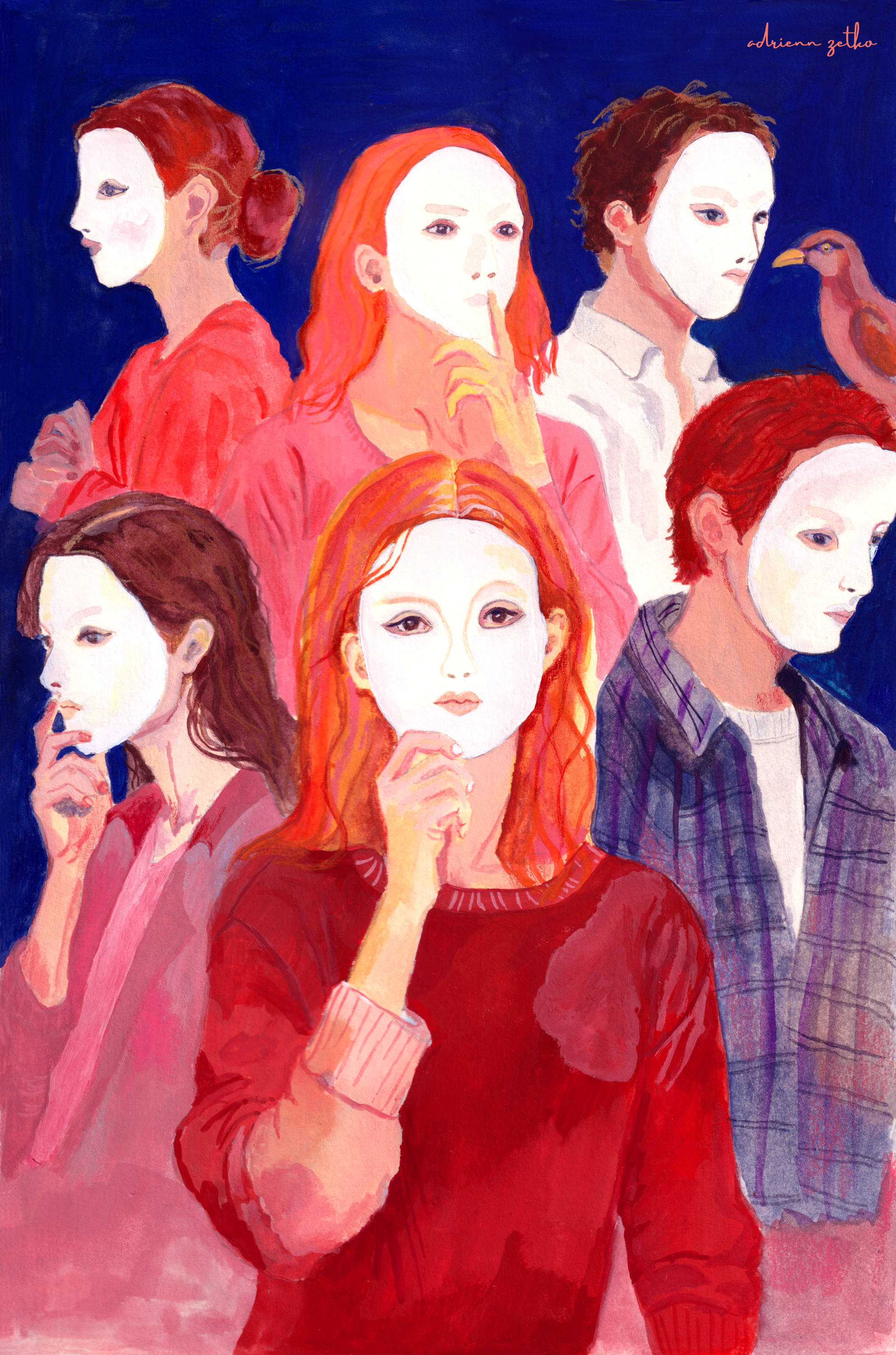
Shall We Take Off the Mask?
How Much of the Artist Should We See?
As a new year opens, I find myself returning to a question that keeps resurfacing — quietly, insistently — whenever I sit down to paint, and again whenever I share the finished piece into the bright, fast world of the internet:
How much of me belongs in what I make?
Not in the brushstrokes (those are already mine), not in the palette or the paper or the steady patience of layering colour. I mean something else. The person behind the work. The private life. The voice. The face. The story. The small daily details that, once shared, can never be unshared. In other words: Who are we, as artists, when we show our work? And how much are we expected to reveal before someone believes we are real?
There are days when it feels as if art is no longer allowed to arrive alone.
A painting steps forward, and immediately a second presence is demanded beside it: the maker, standing under bright light, explaining, proving, performing. Where was this made? What were you feeling? What is your story? What are you like in the morning? What do you eat? What do your children look like? Where do you live? What struggles did you overcome to deserve being seen? Sometimes these questions are tender. Sometimes they are curious in a beautiful way — because connection is one of the most human hungers. And still, I find myself pausing.
Because there is a thin line between inviting someone in and handing yourself over.
The New Expectation of Visibility
We live in an era where visibility is often treated as a kind of currency. The more you share, the more you are rewarded with attention. The more personal the details, the more “authentic” you appear. And authenticity, these days, is almost a requirement — especially for artists, whose work is already made of feeling and vulnerability. But the word “authentic” has become slippery. Sometimes it means truth. Sometimes it means access. Sometimes it means you must keep a door open at all times, so others can look in and decide whether you are worthy of their trust.
Yet I wonder: Is authenticity really measured by how much we reveal? Or is it measured by something quieter — something deeper? Maybe authenticity is not the full story, but the honest gesture. Maybe it is the care. The intention. The way a line is drawn with attention rather than haste. Maybe it is the refusal to imitate a louder world. And maybe — just maybe — privacy does not contradict sincerity. Maybe it protects it.
The Studio Is Not a Stage
There is a certain tenderness in the studio: the unfinished pieces, the experiments that don’t work, the papers that curl at the edges, the colours that go muddy before they find their balance. It is a place where I can be unobserved. And that matters. Because not everything grows well under constant watching.
Social media, newsletters, websites — these can be beautiful bridges. They can also become stages that never close. And when the stage lights stay on too long, the artist begins to confuse being seen with being exposed.
I think many of us know this feeling: You want to share your work, because it’s how it finds its people. You want to speak, because language can offer context, warmth, connection. But you also want to keep something for yourself — some quiet corner that remains untouched by opinion, algorithms, and the endless appetite of the scroll.
So where is the balance?
A Boundary Can Be a Form of Love
Here is something I am learning slowly: A boundary is not a wall. It can be a frame. When we set boundaries around what we share, we are not withholding the “real” version of ourselves. We are choosing what belongs in public space — and what deserves a softer, safer home. And perhaps this is especially true for artists.
Because art already contains us, in a way that is difficult to explain. Even if we never show our faces, even if we never tell our biographies, the work carries our rhythm. Our choices. Our gaze. It reveals what we notice, what we return to, what we cannot stop thinking about. That is not nothing. That is not “less authentic.” Sometimes, the most personal thing we can offer is not a confession, but a vision.
A painted sky can be more intimate than a photograph of a breakfast table.
A quiet landscape can hold a whole lifetime of longing.
A single bird in motion can say what words cannot.
So maybe the question is not “How much should I show?” Maybe the question is: What kind of connection do I want to create?
The Difference Between Presence and Performance
There is a difference between being present and performing. Presence is when I write to you like this — honestly, gently, without trying to manufacture a persona. Presence is when I share the work, and a few words that help you enter it, and then I step back. Presence is when the art remains the centre of the room. Performance is when the self becomes the product.
And this is where it becomes complicated, because the internet often rewards performance. It rewards speed, frequency, emotional intensity, and a kind of constant disclosure. But art has never been made that way. Art asks for another pace. Another kind of attention. And if art asks us to slow down —perhaps the artist deserves to slow down too.
So, Who Are We?
Maybe we are not one fixed thing. Maybe we are makers, and parents, and observers, and dreamers, and tired humans with laundry waiting in the next room. Maybe we are private and public in different measures on different days. Maybe we are allowed to change our minds. Maybe we are allowed to keep parts of ourselves out of view.
And still, we are real. Not because we share everything. But because we make something with care — and offer it.
If you are an artist reading this, I hope you hear it clearly:
You do not owe the world your entire life in exchange for being seen.
You are allowed to choose.
You are allowed to protect the quiet places where your work is born.
And if you are a viewer reading this — someone who pauses, someone who looks slowly — thank you! Because perhaps the most respectful way to meet an artwork is not to demand the artist’s full story, but to listen to what the piece is already saying.
To stand in front of it and let it speak. That, too, is a kind of intimacy.
Until next time,
Adrienn